Saturday, 9 May 2015

White and PinkTulips


Whilst doing my weekly shop at the local supermarket, I could not resist adding this lovely bunch of  tulips to the trolley.
What really attracted me to them - apart from the fact that I love painting tulips - was the very delicate colours which had a sort of sugar icing feel to them, which I thought I might attempt to capture. The darker flowers had the same sort of bloom to them that can appear on plums and grapes etc, so I knew it was going to be a challenge.


There is not a lot to say about the process, my palette and paper were the same as always, and I started with colours dropped onto wet paper which I allowed to merge into themselves, being especially careful with the greens to avoid losing the freshness, which can happen when they run into other colours.


When the wash was dry, I drew in the shapes of the flowers lightly in pencil, placing the shapes where the background suggested they should go, looking for areas on the perimeter where I could lose some of the edges, to keep it loose.


Then it was just a question of painting in the shapes, using a selection of pinks and blues, blotting out areas which I wanted to keep white, and making sure the stems looked natural as they passed behind other flowers.
I painted both flowers and leaves together as this helped me to see how the composition was developing, and as usual, I painted up to but not over the lines, so that when the paint was dry, they could be erased.


I tried to keep the leaves as delicate as the flowers, but I am aware that they would normally be a stronger green than this.
I finished by adding some white acrylic gouache to some of the tulips to hopefully give that 'bloom' mentioned earlier, and then my normal light splatter of the same gouache to hopefully loosen up the image a bit.


                                                              'Pink and White Tulips'
                                          Watercolour on Fabriano Artistico Extra White
                                                                 300g rough paper


Monday, 13 April 2015

Paintings at Art Group: Catch-up

Time seems to be whizzing away, and with all the family issues that have needed dealing with over the past couple of months, painting, except on a Thursday morning, has had to go on the back burner. It means that I have only produced art fulfilling the group programme and there are no accompanying process photos, but I thought I would post the paintings to keep the blog active before I write another post in my usual style.
So this is what we have been getting up to over the last few weeks at Avon Valley Artists Group.....


GLASS AND/OR CHINA


ANIMALS


SUNLIGHT AND SHADOWS


RAINBOW OF COLOURS


RURAL BUILDINGS (after John Blockley)


I hope you enjoy looking!
 

Saturday, 4 April 2015

Rhubarb


As The topic at Avon Valley Artists was Fruit and/or Vegetables, I looked out a small picture of Rhubarb that I had keep for ages with the intention of having a go at painting it. I think I must have been mad. I can honestly say that the leaves of the plant were probably the hardest set of inanimate objects that I have ever tried painting!!
I did not discover this until it was well under way. I had done a fairly loose drawing of the leaves and just thought that I would deal with the 'how' later. I might have given up before I started otherwise!


Once the drawing was ready, I started with the sticks of fruit and their background, trying to vary the colours a bit to make them more interesting. I worked from the centre outwards and left some slightly more yellow than the bright pinks in the middle 


I tackled the leaves, by painting very pale backgrounds of Naples Yellow and then using stronger yellows and greens, including Yellow Ochre, and Serpentine Green to paint around the veins allowing the background colour to be seen.
As I moved across the paper, I tried to get darker and freer, using Apatite Green Genuine with the Serpentine Green to produce the variety of colours. I then added some very dark green in he top RH corner to give some depth.

Writing this description makes it all seem so simple, but the leaves of Rhubarb are very distinctive and  I did want to portray their blousy ebullient character and did not want them to appear flat. It took a long time and I was never really sure it was going to work.


Since finishing the painting, I thought the sticks seemed a little pale, so I added a bit more colour so that the painting did not seem so top heavy.

                                                                         'Rhubarb'

                             Watercolour on Fabriano Artistico Extra White 300 gm paper

Thursday, 12 March 2015

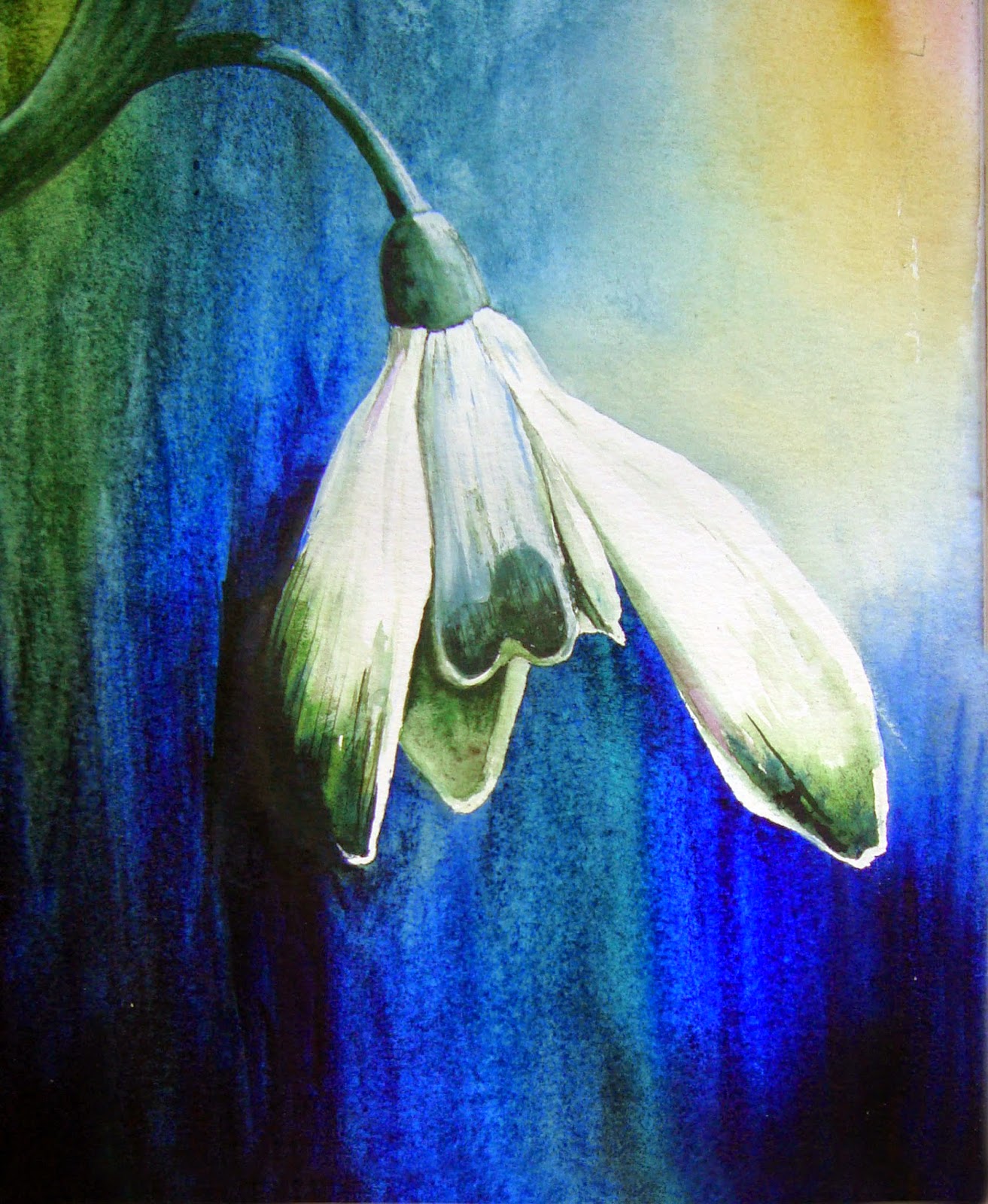
Snowdrops

 
There has been a bit of a thing going this month with Snowdrops!  When the subject at Avon Valley Artists was 'Moody Blues' I painted the  delphiniums shown in the previous post. One of the other members of the group painted a snowdrop from the picture below, which I think appeared in an issue of Gardens Illustrated magazine. She was not very happy with the result and asked if I would like to borrow the picture and have a go myself.


I used some 450gm Cornwall Matt paper, knowing that the background was going to need lots of washes. I did a simple pencil drawing, and applied a border of masking fluid around the edge of the flower. This way, I did not need to be too careful about the washes as the edge of the flower was protected. I used combinations of Apatite Green Genuine, Indigo, Ultramarine Blue, Winsor Green, Teal Blue, Indian Yellow and Quinachridone Pink to create the background. I  put on the washes, being careful not to go over the same place twice, adding one colour at a time and allowing it to dry thoroughly. The edge of each wash was mopped and dried with tissue so that there was no hard edge of any colour and the colours all looked as if they has merged naturally.
 
I then painted in the single snowdrop and stems, trying to create a lost edge on the LH side. The added dark ink seems a bit harsh, but in the actual painting, there is no solid line where the extra colour meets the original washes. 


When the painting was complete, I realised that I rarely painted snowdrops in the past, but the little clump in the garden has spread a bit and I was able to pick a couple to bring indoors. They have such a short season, so I also used some garden magazine photos, to give me a variety of growing positions.
I wanted this painting to be a delicate clump, so I did a careful pencil drawing, which I would remove as usual as the painting progressed.
I started by painting the central darks around the stems and then worked out from the middle


I had chosen to paint the variety with dark green markings on the petals, but in hindsight, I do wonder if I would have been better to paint the snowdrops with plain white outer petals. I think the painting has become a bit fussy as a visual image. I am not saying that I am displeased with the finished result, just that there may be a bit too much green and not enough striking white. (Although very little of a white petal is actually white)


When the painting was complete, I thought the leaves on the LH side were a bit pale against such a dark background and they stood out too much, so, since this photo was taken, I have darkened those leaves, and it greatly improved the balance.

Tuesday, 24 February 2015

Moody Blues : Delphiniums

This week at Avon Valley Artists was a bit strange!
The subject was 'Moody Blues', any interpretation, any medium. I, of course, chose to paint some flowers, so I looked out a source photo from the great amount that I have amassed and was surprised how few, by comparison to other colours that were in the folders,

I chose a couple of straightforward photos of Delphiniums and though they would do.


The evening before the group meeting, I used a sheet of Cornwall 450g matt paper and produced the background wash for the painting. I lightly sprayed the paper with clear water and then dropped paint onto the wet surface, using dark, medium and lilac based blues.

As I was going top have to give the flowers some definition, I used a little ball of tissue paper to blot out small areas of paint within the bands of colour whilst the paper was still very damp.

I then left the painting to dry completely over night knowing that, at this weight, the paper would return to completely flat once dry.

The following morning, off I went to the group. As we were setting up ready to work, I laughingly said that I would make the coffee and chat all morning as I thought the background wash was a painting in its own right. I was joking of course, but after all those interested had had a good look, they agreed and refused to allow me to touch the work.

This meant that I had no prepared paper for a mornings work, in fact I had no paper at all. I had to 'borrow' a sheet from a friend and set to,  to produce something for the critique at the end, even though this could be an unfinished piece of work

I do not know if we are right or not, but I now have two paintings of  'Delphiniums' both from the same source material, one very delicate and abstract and the other much more full on and hopefully fulfilling the 'Moody Blues' bit !!
I include both paintings here for you to judge for yourselves.

                                                         
                                                           Cornwall 450gm Matt Paper
                                                                       Wash only


                                                    Fabriano Artistico Rough 300g Paper
                                                             Wash and over painting

Saturday, 21 February 2015

Daffodils and Alstroemeria

 
I seem to have had a bit of a yellow thing going on at the moment. The local supermarket was selling bunches of daffodils for less than a pound each, and after inviting some friends to dine with us, they arrived with a beautiful bunch of mixed yellow flowers.
Once they were both in water, I could not resist having a go at the daffodils and the alstroemeria whilst they were still fresh.
I find any trumpet shaped flowers quite difficult, so they were both a bit of a challenge, as was keeping the colours as fresh as possible, especially in the shadow areas. I painted them both in the same way, I applied a pale loose wash to the lightly sprayed paper. In order to keep it fresh, I dropped the paint onto the paper and allowed the various colours to mix themsel;ves.
 
I then did a light pencil drawing to get the composition about right and then tackled the flowers themselves. I was aware that they could all end up very 'tight' so I did try to keep some lost edges and free washes, but I still think they both should have been a bit looser. Case of must keep trying, could do better!
 
Once the flowers were finished , I darkened the centre background to help throw the flowers forwards, erased the pencil lines where possible, and tweaked the odd shadows. Both paintings were worked on 'Leonardo Matt' paper and the only addition to my usual palette, was Serpentine Green from Daniel Smith.


                                                                         'Daffodils'

 
'Alstroemeria'

Apologies that the photos seem a bit too orange. The result of taking the photos at night I presume.

Wednesday, 4 February 2015

Caryopteris Revisited

A couple of posts ago, I published what I thought was quite a disappointing painting of Caryopteris done from a lovely photo given to me by Peter Ward, a painting colleague.
H suggested that if I was unhappy with the result, I should have another go. talking about the painting to my painting mate, Jan, we decided that rather than have another go on a new piece of paper, it would be worth putting the first effort under the cold tap, giving it a gentle but thorough scrub, and allowing it to dry.
It was only possible to do this because the painting had been done on a sturdy paper - Fabriano Artistico Rough. Had the painting been done on 'Cornwall' matt paper, I do not think this would have been possible. I am sure I would have rubbed the top surface away.

Once the sheet of paper has dried, I then attempted to repaint it, trying to keep it a bit less heavy, and altering the composition slightly.
I forgot to take a photo of the sheet completely washed, before I started to repaint, but in the photo below, you can see what the painting looked like from the bottom half of the photo, which has not yet been retouched.


As you can see, I started repainting from the top, As I wanted the buds to be much lighter, I did have to mix the Cobalt Blue with some white acrylic gouache, but in lots of places the paint had come away enough to use pure Cobalt. To make a strong contrast between the paler flowers and the background I started adding darks between the stems, some green and some dark blue and some blue and magenta mix.

I reworked all parts of the painting in this way, and altered the composition by adding another stem and more leaves, and faint suggestions of more buds in the LH background.


Although I would not claim to have produced one of my best images, I do think the painting is an improvement on the original, and it was an interesting experiment, proving that although watercolours can be very unforgiving when one makes a mistake, maybe there are ways in which we can improve the final result. I have included the original final image below so that the two can be compared without seeking out the previous Caryopteris post. (But you will need to go to that post if you want to see the original photo......although I have still not done it justice!)